ULA Vulcan Rocket Failure Destroys 40 Amazon Leo Satellites in ULA’s First-Ever Mission Loss

A United Launch Alliance Vulcan rocket failed about ten minutes after liftoff on Sunday, 15 November 2026, destroying all 40 Amazon Leo internet satellites it carried from Cape Canaveral Space Force Station in Florida.
The ULA Vulcan rocket failure is the first outright mission loss in the company’s 20-year history, and it struck on the very first of 38 Vulcan launches Amazon had booked to build its satellite internet constellation.
Ten Minutes Into the Flight, Something Went Wrong
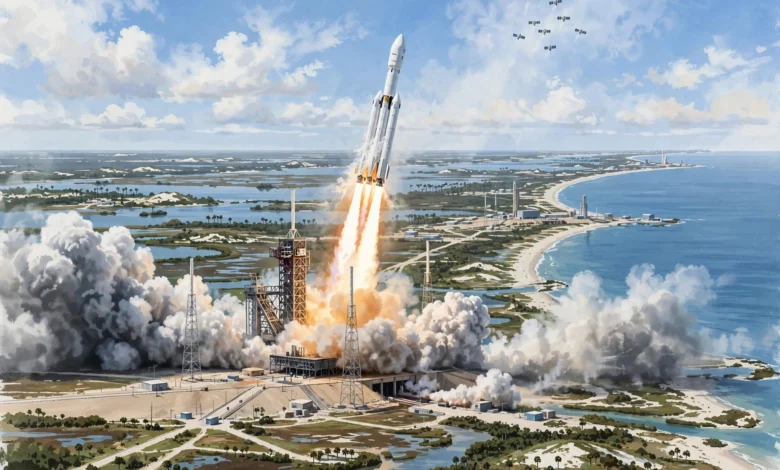
The 214-foot rocket lifted off from Space Launch Complex 41 at 12:40 p.m. ET, after two days of delays and a countdown hold with 20 seconds left to resolve a technical issue. Its six solid rocket boosters and two Blue Origin BE-4 engines performed normally through the early climb, and the Centaur upper stage ignited as planned.
The trouble came about ten minutes into the flight, during the Centaur’s burn, after the first stage had separated and the payload fairing had jettisoned. ULA confirmed the outcome in a statement issued about 50 minutes after liftoff: “Based on data received by our Launch Director, we confirm that the Vulcan vehicle launched from Space Launch Complex 41 suffered an anomaly 10 minutes into the flight and failed to deliver the Amazon mission to orbit.”
ULA said it did not yet have specific data on what went wrong. The company added: “We will work closely with our customer and other appropriate organizations to find the cause, determine the appropriate corrective action and return to flight as quickly as possible.”
A First Failure in ULA’s 20-Year History
United Launch Alliance, a joint venture of Boeing and Lockheed Martin formed in 2006, had never lost a mission outright before Sunday. The flight was only the fifth for Vulcan, the rocket built to replace ULA’s Atlas 5 fleet, and its first in nine months.
The nine-month gap followed problems on earlier flights. A solid rocket booster nozzle malfunction marred the 12 February USSF-87 national security launch, and separate technical investigations into the boosters and the BE-4 engines kept Vulcan grounded until this weekend. A Reuters report noted the failure is expected to lead to a lengthy investigation that could keep the rocket out of service for months.
| Vulcan mission | Detail |
|---|---|
| Launch date | Sunday, 15 November 2026, 12:40 p.m. ET |
| Launch site | Space Launch Complex 41, Cape Canaveral, Florida |
| Payload | 40 Amazon Leo internet satellites |
| Failure point | About 10 minutes in, during Centaur upper stage burn |
| Vulcan flight number | 5th since January 2024 debut |
| ULA mission failures before this | None since the company formed in 2006 |
| Amazon Vulcan launches contracted | 38 |
| Leo satellites deployed so far | About 398 across 14 launches since April 2025 |
What the Loss Means for Amazon Leo
Amazon Leo is the company’s planned rival to SpaceX’s Starlink, and Sunday’s mission was meant to be the opening flight of a 38-launch Vulcan campaign. Losing 40 satellites in one flight is a setback, but the constellation’s scale puts it in perspective: about 398 Leo satellites have already reached orbit since April 2025, against roughly 3,236 planned for the first constellation.
The timing is awkward for Amazon. The larger Vulcan carried 40 satellites on Sunday, compared with 29 on the most recent Atlas 5 launch, so the rocket was supposed to speed up deployment, not slow it down. A CGTN report on the failure noted that Amazon needs the full constellation in place to offer high-speed coverage to customers around the world.
For ULA, the stakes are just as high. Vulcan is its flagship rocket, and Amazon is its biggest commercial customer. The company must now find the cause, fix it, and convince both Amazon and the U.S. government that the rocket is ready to fly again.
What Happens Next: Investigation and Return to Flight
The Federal Aviation Administration has said ULA must conduct a mishap investigation, and the company will have to submit a final report identifying the root cause and the corrective actions needed to prevent a repeat. No timeline has been set for the investigation or for Vulcan’s next flight.
NASA Administrator Jared Isaacman has offered his agency’s assistance with the investigation. Until ULA pinpoints the fault, the rest of Amazon’s launch schedule — including the remaining 37 contracted Vulcan flights — is on hold.
The failure is a reminder of how unforgiving orbital flight remains, even for a company with two decades of launches behind it. It also underlines how much of the space race now runs through the night sky: while the Leonid meteor shower peaks over the Northern Hemisphere this week, the satellites meant to join the constellations above it will have to wait for ULA’s answers. The contrast with the weekend’s other big space story is sharp — the SpaceX Starship tower landing showed a booster coming home, while Vulcan’s payload never reached orbit at all.
Frequently Asked Questions
What happened to the ULA Vulcan rocket on 15 November 2026?
The Vulcan rocket suffered an anomaly about ten minutes after liftoff from Cape Canaveral and failed to deliver its payload of 40 Amazon Leo satellites to orbit. All 40 satellites were lost.
How many Amazon Leo satellites were lost in the failure?
Forty satellites were aboard the Amazon Leo 1 mission, and all were lost. Amazon had already deployed about 398 Leo satellites on earlier launches, so the constellation itself continues, but the loss removes a full batch from its deployment plan.
Has ULA ever lost a rocket before?
No. Sunday’s flight was the first outright mission failure for United Launch Alliance since the Boeing–Lockheed Martin joint venture was formed in 2006. Earlier Vulcan flights had partial problems, including a booster nozzle issue in February 2026, but none had failed to reach orbit.
What is Amazon Leo?
Amazon Leo is Amazon’s satellite internet network, designed to compete with SpaceX’s Starlink. Amazon plans about 3,236 satellites for its first constellation and had contracted ULA for 38 Vulcan launches to help deploy them.
When will the Vulcan rocket fly again?
No date has been given. The FAA requires a mishap investigation, and ULA must submit a final report on the cause and corrective actions before returning to flight. Reports suggest the investigation could keep Vulcan grounded for months.