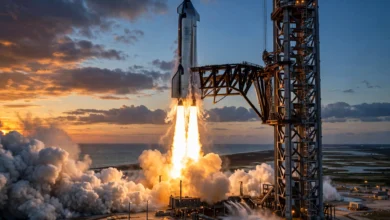
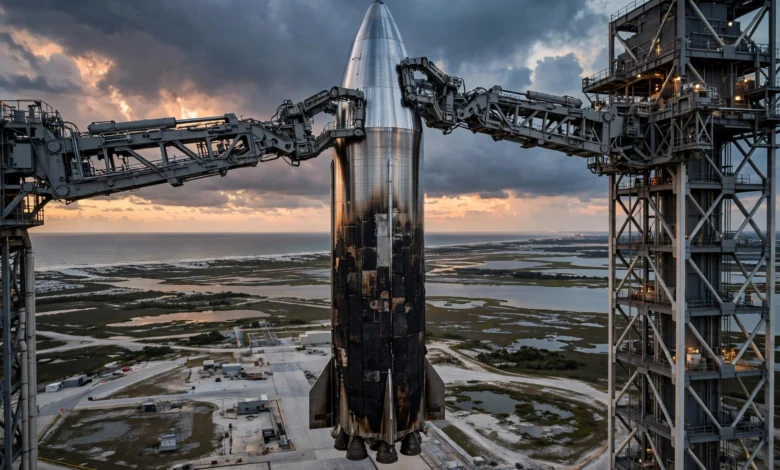
SpaceX caught its Starship spacecraft with the giant mechanical arms of its Texas launch tower on Saturday, 14 November 2026, completing the first tower landing of a spacecraft returning from orbit. The 52-metre ship, known as Ship 42, dropped out of thick cloud over Starbase, Texas, reignited its engines and settled gently into the arms, known as Mechazilla, about 22.5 hours after lifting off.
It was the second half of a mission that had already gone partly wrong. The giant rocket reached orbit on Friday on Flight 15, but the Super Heavy booster was diverted over the Gulf of Mexico minutes after liftoff and exploded. Saturday’s catch salvaged the flight and gave SpaceX the milestone it had chased since it began flying Starship in 2023.
Mechazilla’s arms closed around Ship 42
The ship fired one of its Raptor engines at about 2:25 p.m. Central time on Saturday to begin its plunge back through the atmosphere, after circling Earth 14 times. It re-entered over the Pacific, swung out over the Gulf of Mexico and then turned back toward the Texas coast.
Emerging from cloud, the charred spacecraft lit three Raptor engines, flipped itself upright and slowed to a hover beside the launch tower. Two small fittings near the top of the ship then settled onto the tower’s mechanical arms, and the ship hung still a few hundred feet above the ground, its engines shut down.
“Mechazilla catches Starship! Congratulations to the entire SpaceX team on this incredible achievement!” the company posted on X at about 3:21 p.m. Central time. The ship returned from a 22-hour voyage in orbit, according to Reuters, in the longest Starship mission yet flown.
Fourteen orbits, 26 satellites and a 22-hour round trip
Flight 15 was the fourth launch of the upgraded Version 3 Starship and only the second time a Starship upper stage has reached orbit, after Flight 14 in September. While cruising at an altitude of about 260 kilometres on Friday night, the ship released 26 Starlink V3 satellites, the most advanced version of SpaceX’s internet spacecraft.
| Time | What happened |
|---|---|
| Friday 13 Nov, 5:48 p.m. ET | Liftoff from Starbase, Texas, on Flight 15 |
| About 6½ minutes in | Booster catch aborted; booster diverted to the Gulf of Mexico |
| About 27 minutes in | Ship 42 reaches Earth orbit |
| Friday night | 26 Starlink V3 satellites deployed at about 260 km altitude |
| Saturday 14 Nov, about 2:25 p.m. CT | Deorbit burn begins after 14 orbits and 22.5 hours in space |
| Saturday 14 Nov, about 3:21 p.m. CT | Tower arms catch Ship 42 at Starbase — a first for a returning spacecraft |
The booster that did not come home
The mission was designed to recover both halves of the rocket at the launch site in a single flight, something no orbital rocket has ever done. The Super Heavy booster was meant to fly back to the tower about six and a half minutes after liftoff, but its boostback burn ended early after a low-fuel-mass alarm.
Controllers steered the booster over the water instead, and SpaceX later confirmed that its flight termination system was triggered as it came down softly over the Gulf, ending in a fireball above the sea. Elon Musk said on X that low fuel was the initial reason for the diversion, but that flight telemetry would need to be reviewed before a definite conclusion.
SpaceX had already caught a Super Heavy booster three times, on Flights 5, 7 and 8. The loss of this one, a new Version 3 production model built for Moon and Mars missions, means the company has still not recovered both stages of one flight.
Why a caught spaceship changes the maths of spaceflight
No rocket has ever been recovered in full after flying to orbit. SpaceX’s smaller Falcon rockets reuse only their first stage, while the second stage is discarded on every flight. Catching both halves of Starship would let the company refly the entire vehicle, cutting costs and raising launch rates sharply.
That is the core of Musk’s plan to build Moon bases and send people to Mars, and it matters to NASA too. The agency is paying SpaceX billions of dollars to land Artemis astronauts on the Moon with Starship, and the rocket’s ability to fly again quickly is central to that schedule.
The launch closed a chaotic day for American aviation, coming hours after the nationwide FAA ground stop halted every departing flight in the United States on Friday. SpaceX lists the flight’s landing site as Mechazilla on its Flight 15 mission page.
What SpaceX still has to prove
Catching the ship does not yet prove it can fly again. SpaceX has not said whether Ship 42 will be reflown, and the company is still working to reduce the maintenance its heat shield needs between missions. The ship returned visibly charred from the heat of re-entry.
SpaceX plans to start launching Starships from Florida within a few months, as it works toward weekly launches by the first half of 2027. If the company can turn around a caught ship as quickly as it turns around a Falcon booster, the economics of going to space change for everyone.
SpaceX Starship tower catch: questions answered
Has a Starship ever been caught by the tower before?
Not the ship. Saturday was the first time the Starship upper stage has been caught after returning from orbit. SpaceX had previously caught the Super Heavy booster three times, on Flights 5, 7 and 8.
How long was Ship 42 in space?
About 22.5 hours. It completed 14 orbits of Earth after lifting off on Friday evening, 13 November, and was caught at about 3:21 p.m. Central time on Saturday, 14 November.
What happened to the Super Heavy booster?
The booster catch was aborted about six and a half minutes after liftoff when its boostback burn ended early after a low-fuel-mass alarm. It was diverted over the Gulf of Mexico, where its flight termination system was triggered and it exploded above the water.
Did Starship carry anything into orbit?
Yes. It deployed 26 Starlink V3 satellites, the most advanced version of SpaceX’s internet spacecraft, while cruising at an altitude of about 260 kilometres on Friday night.
Will Ship 42 fly again?
SpaceX has not said. Recovering the spacecraft does not yet show it can be reflown without extensive refurbishment, and the company is still working on reducing heat-shield maintenance between flights.