
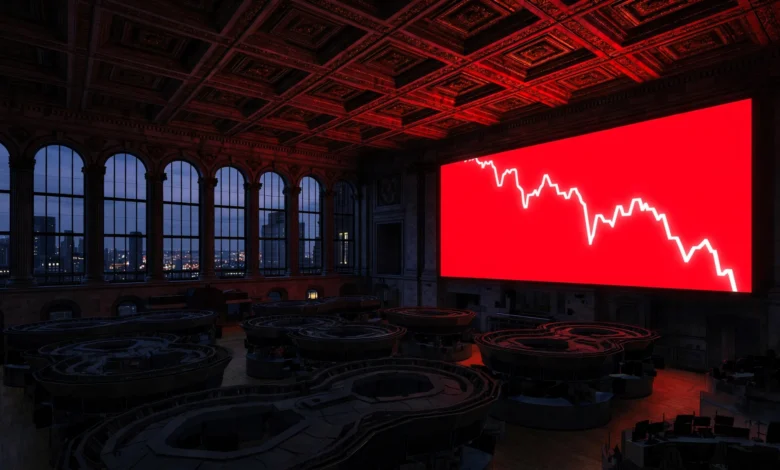
Wall Street’s stock market sell-off intensified on Friday, 20 November 2026, as investors in New York dumped artificial intelligence shares and pushed the Dow Jones Industrial Average and the S&P 500 into correction territory. The Nasdaq Composite wiped out its gains for the year in the same session, capping the market’s worst week since the spring tariff turmoil.
The Dow fell 949.73 points, or 1.93 percent, to close at 48,147.33, while the S&P 500 lost 265.44 points, or 3.7 percent, to 6,910.39. The Nasdaq Composite dropped 1,261.47 points, or 5.28 percent, to 22,617.73, according to CNN’s market report on the session.
Friday closing levels in the stock market sell-off
| Index | Friday close | Change | Percent change |
|---|---|---|---|
| Dow Jones Industrial Average | 48,147.33 | -949.73 | -1.93% |
| S&P 500 | 6,910.39 | -265.44 | -3.70% |
| Nasdaq Composite | 22,617.73 | -1,261.47 | -5.28% |
The S&P 500 posted its seventh consecutive daily loss, its longest losing streak since February 2020. The Dow recorded its fifth straight drop of more than 1 percent and finished the week down 8 percent, its worst week since March 2020.
Both benchmarks closed more than 10 percent below their record highs, the standard definition of a correction. The Dow peaked on 5 August 2026 and the S&P 500 on 6 October 2026, and the Reuters session recap confirmed both indexes had entered correction territory.
Nasdaq erases its 2026 gain
The Nasdaq had been up as much as 18.7 percent for the year at its 6 October record high. Since that peak the index has shed roughly $8.7 trillion in market value and is now down more than 2 percent for 2026, about 18 percent below its high.
The reversal is a sharp turn from earlier this month, when the Dow surged 1,100 points in its best day since April. That rebound lifted all three indexes, but the buying did not hold as AI worries returned.
Chip stocks lead the slide
Semiconductor shares bore the brunt of Friday’s selling. Nvidia fell 14 percent, its worst day in almost two years, while Advanced Micro Devices sank 13.3 percent, Micron Technology slid 13.9 percent and Broadcom dropped 12.2 percent.
Nvidia is down 22.9 percent for the week and 47.5 percent since its 6 October peak, erasing about $2.7 trillion in value. The slide followed Nvidia’s record quarterly results earlier in the week, which failed to calm questions about AI spending returns.
Anthropic also fell in its second day of trading. The AI lab’s shares dropped 8.5 percent to $88.91, just above the $83 IPO price, after the record Anthropic IPO debut on Thursday had closed up 17 percent.
Why investors are selling AI shares
Strategists pointed to growing doubts about whether hundreds of billions of dollars in AI data-centre spending will earn an adequate return. Uncertainty over the pace of data-centre construction after the midterm elections added to the pressure, alongside reports of regulatory scrutiny of Nvidia.
Federal Reserve expectations also weighed on sentiment. Governor Lisa Cook said the policy rate is not high enough to deal with current inflation, and markets moved to price a near-certain 25-basis-point hike at the December meeting.
Not every stock fell. Defensive names such as General Mills, Walmart, Costco, Johnson & Johnson and Procter & Gamble gained ground, and Treasury bonds rallied as the yield on the 10-year note eased to 4.93 percent.
Fear gauge jumps as losses spread overseas
The CBOE Volatility Index, known as Wall Street’s fear gauge, surged 86 percent for the week to close at 35.89, its highest level in 19 months. Readings above 20 are generally taken to signal heightened investor uncertainty.
The selling spread beyond the United States. Japan’s Nikkei 225 fell more than 5 percent overnight and South Korea’s Kospi dropped by a similar margin, while European indexes also closed sharply lower.
Volume on U.S. exchanges reached 25.19 billion shares, well above the recent 20-day average of 19.50 billion. Declining issues outnumbered advancers by more than 3-to-1 on the New York Stock Exchange and by more than 4-to-1 on the Nasdaq.
What traders watch next week
Investors now look to the personal consumption expenditures price index due next week for fresh guidance on inflation. The report follows a hotter-than-expected October inflation reading and will shape expectations for the Federal Reserve’s December decision.
Consumer sentiment offered one bright spot. The University of Michigan’s latest survey rose sharply from last month, helped by easing gas prices and improved expectations for business conditions after the midterms.