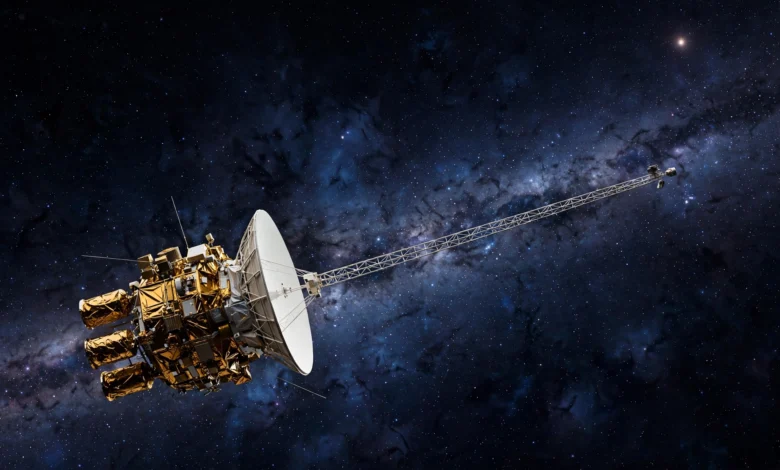
NASA’s Voyager 1 became the first human-made object to reach one light-day from Earth on Wednesday, 18 November 2026, crossing a distance of more than 16 billion miles after nearly 50 years in space. The probe passed the mark at 5:16:07 a.m. EST, according to NASA’s calculations, and now sits so far from home that a radio signal takes a full day to reach it.
A Day-Long Wait for Every Signal
A light-day is not a measure of time. It is the distance light travels in 24 hours, roughly 16 billion miles, or 25.9 billion kilometres. Voyager 1 covered that ground at about 38,000 miles per hour, a journey that began with its launch from Cape Canaveral, Florida, on 5 September 1977.
The distance changes how the mission works. A command sent from Earth through NASA’s Deep Space Network now takes 24 hours to arrive, and the probe’s reply takes another 24 hours to come back. Voyager project manager Suzanne Dodd has described the rhythm plainly: send a message, then wait two days for the answer.
It is a milestone with no physical marker. Nothing on the spacecraft switched on or changed course as it crossed the line. The achievement is one of endurance, a machine built in the 1970s still flying, still answering, from beyond the Sun’s protective bubble.
Two Instruments Still Listening After 49 Years
Voyager 1 left Earth carrying 10 science instruments. Only two still operate: the magnetometer, which measures magnetic fields, and the Plasma Wave Subsystem, which listens to waves in the thin gas between the stars.
The rest were switched off one by one to save power. The Cosmic Ray Subsystem went quiet in February 2025, and the Low-Energy Charged Particle instrument followed in April 2026. Both spacecraft run on plutonium-238 generators that lose about four watts of power every year.
In September, engineers completed a power-saving swap nicknamed the “Big Bang,” turning off three devices on Voyager 1 and switching on three lower-power replacements at the same time. NASA said that without the work, another science instrument would have had to be shut down as early as summer 2027.
| Voyager 1 at a Glance | |
|---|---|
| Launched | 5 September 1977, Cape Canaveral, Florida |
| One light-day crossed | 18 November 2026, 5:16:07 a.m. EST |
| Distance from Earth | About 16.09 billion miles (25.9 billion km) |
| Speed | About 38,000 mph (61,000 kph) |
| Signal delay | 24 hours each way; 2 days for a round trip |
| Instruments operating | 2 of 10 — magnetometer and Plasma Wave Subsystem |
| Entered interstellar space | August 2012 |
| Twin spacecraft | Voyager 2, launched 20 August 1977 |
The 48 Hours Voyager 1 Went Silent
The milestone arrives weeks after a scare that showed how fragile the mission has become. On 18 and 19 October, NASA’s Deep Space Network could not find Voyager 1’s signal during two scheduled contacts, 24 hours apart.
The signal returned on 20 October, before engineers had sent any troubleshooting commands. They later found that one set of thrusters had gone offline and backup thrusters had taken over automatically, a fault-protection response that steadies the spacecraft and pauses normal operations. The underlying cause is still under investigation.
Voyager 1 has held the title of farthest human-made object since 1998, when it passed the Pioneer 10 probe. It crossed into interstellar space in August 2012, leaving the heliosphere, the bubble of solar wind that surrounds the Sun.
How NASA Is Marking the Milestone Today
NASA’s Jet Propulsion Laboratory in Southern California hosts a moderated discussion later today, Thursday, at 12 p.m. EST (10 p.m. PKT), in the von Kármán Auditorium, streamed live on NASA’s channels. NASA laid out the day’s schedule in its Voyager announcement, which lists the discussion, a question-and-answer session and a preview of a Voyager documentary planned for NASA+ in 2027, the mission’s 50th anniversary.
The panel brings together Nicky Fox, associate administrator of NASA’s Science Mission Directorate; JPL chief scientist Jonathan Lunine; Voyager project manager Suzanne Dodd; project scientist Linda Spilker; mission manager Kareem Badaruddin; and deputy project scientist Jamie Rankin.
The public already had its part. On Tuesday evening, NASA invited people around the world to flash lights skyward after sunset for “Shine Bright for Voyager’s Light-Day,” a symbolic wave of golden light to mark the probe’s journey.
What Comes Next for the Farthest Spacecraft
Voyager 1 keeps moving away from the Sun at more than 3 astronomical units a year, drifting in the general direction of the star Gliese 445, about 17 light-years away. Its twin, Voyager 2, trails behind and is not expected to reach one light-day until around 2035.
NASA hopes to keep hearing from Voyager 1 into the early 2030s, though its fading power supply sets a hard limit. NASA’s Voyager mission page tracks the positions of both spacecraft as they travel deeper into interstellar space.
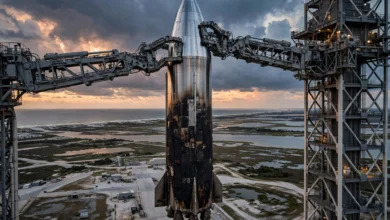
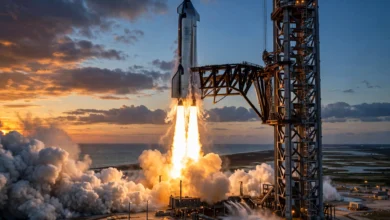
The milestone caps a crowded stretch for American spaceflight, coming days after SpaceX caught Starship from orbit in the first tower landing of a spacecraft returning from orbit. The same stretch also showed the risks, after a Vulcan rocket failure destroyed 40 Amazon satellites on Sunday.
Aboard Voyager 1, the Golden Record still rides along: a gold-plated disc carrying greetings, music and images from Earth, chosen by a committee led by Carl Sagan. No one expects it to be found. It was never really about being found.
Frequently Asked Questions
What is a light-day?
A light-day is the distance light travels in 24 hours, about 16 billion miles (25.9 billion kilometres). It is a unit of distance, not time.
How far away is Voyager 1 now?
About 16.09 billion miles (25.9 billion kilometres) from Earth, and still moving away at roughly 38,000 miles per hour.
How long does a signal take to reach Voyager 1?
About 24 hours each way. A command sent today arrives tomorrow, and the probe’s reply takes another day to come back, so one exchange takes two days.
What instruments on Voyager 1 still work?
Two of the original 10: the magnetometer and the Plasma Wave Subsystem. The other eight were switched off over the years to save the spacecraft’s dwindling power.
How much longer will Voyager 1 keep transmitting?
NASA hopes to keep communicating with the probe into the early 2030s. Its plutonium power source loses about four watts a year, and instruments are switched off as the supply shrinks.