
SpaceX Starship Reaches Orbit as Booster Catch Fails — Ship Aims for First-Ever Tower Catch on Saturday

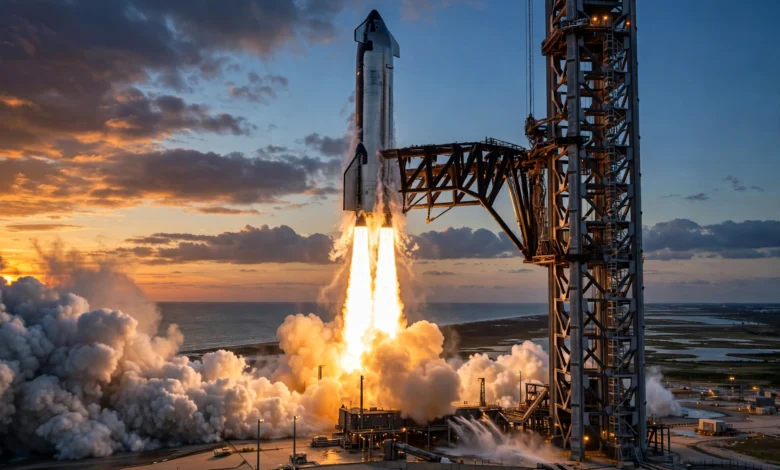
SpaceX’s Starship reached Earth orbit on Friday, 13 November 2026, on the boldest test flight of the giant rocket so far — but the mission’s bid to recover the whole vehicle in a single day came apart within minutes of liftoff from Starbase, Texas, when the Super Heavy booster was diverted over the Gulf of Mexico and exploded.
The 124-metre rocket, the largest and most powerful ever flown, lifted off at 5:48 p.m. Eastern time on its 15th test flight since 2023. It was only the second time a Starship upper stage has reached orbit, after Flight 14 in September, and the first time SpaceX has attempted to catch both halves of the rocket back at the launch pad.
The booster catch was called off minutes after liftoff
The plan called for Super Heavy Booster 22 to fly back to its launch pad about six and a half minutes after liftoff and be caught in midair by the tower’s mechanical arms, known as chopsticks. Instead, for reasons SpaceX has not explained, controllers diverted the booster to a fixed point offshore. It hovered briefly above the Gulf of Mexico, then exploded a short distance above the water.
“Well, that certainly isn’t the news that we had hoped to hear for today,” launch commentator Kate Tice said on the broadcast, adding that the abort followed the mission’s safety checks to protect the pad. SpaceX had already caught three earlier boosters with the tower, but this was the first attempt with the upgraded Version 3 booster, a 72-metre production model built for Moon and Mars missions.
Starship is in orbit — and carrying 26 new Starlink satellites
The ship reached orbit about 27 minutes after launch, according to Spaceflight Now’s live coverage of the flight, and began releasing 26 of SpaceX’s most advanced Starlink satellites, the second operational batch of Starlink spacecraft a Starship has carried into orbit.
The ship will spend more than 21 hours circling Earth before steering back toward Starbase on Saturday afternoon, about 22 hours after liftoff, for the first attempt to catch an upper-stage Starship returning from orbit. SpaceX has said it will only attempt the catch if every system needed to guide the ship through the atmosphere and into the tower is healthy, and it has backup splashdown zones off Hawaii and Chile if controllers decide the landing attempt is unsafe.
Flight 15 at a glance
| Time (Friday 13 Nov, ET) | What happened |
|---|---|
| 5:48 p.m. | Liftoff from Starbase, Texas |
| About 2½ minutes in | Hot-staging separation of booster and ship |
| About 6½ minutes in | Booster catch aborted; booster diverted to the Gulf of Mexico and explodes |
| About 27 minutes in | Ship reaches Earth orbit |
| From about 36 minutes in | 26 Starlink V3 satellites deployed |
| Saturday, about 4:20 p.m. ET | Ship’s planned return and first tower-catch attempt |
Why catching the whole rocket matters
No rocket has ever been recovered in full after flying to orbit. SpaceX’s smaller Falcon rockets reuse only their first stage; the second stage is discarded on every flight. Catching both halves of Starship would let the company refly the entire vehicle, cutting costs and raising launch rates sharply — the core of Elon Musk’s plan to build Moon bases and send people to Mars.
The stakes reach beyond SpaceX. NASA is paying the company billions of dollars to land Artemis astronauts on the Moon with Starship, and the agency has just opened applications for NASA’s next astronaut class, the men and women who will train for the Moon missions Starship is meant to serve.
The launch closed a chaotic day for American aviation, coming hours after a nationwide FAA ground stop halted every departing flight in the United States.
What happens next
All eyes are now on Saturday afternoon, when the ship is due to re-enter the atmosphere and descend toward the launch tower at Starbase. If the catch succeeds, it will be the first time any spacecraft returning from orbit has been plucked from the air by a launch tower — and the first step toward the fully reusable rocket SpaceX has chased since it began flying Starship in 2023.
SpaceX plans to start launching Starships from Florida within a few months, the Associated Press reported, as it works toward weekly launches by the first half of 2027.
SpaceX Starship Flight 15: questions answered
What happened to the Super Heavy booster?
The catch attempt was aborted for reasons SpaceX has not explained. Controllers diverted Booster 22 to a point over the Gulf of Mexico, where it exploded a short distance above the water about six and a half minutes after liftoff.
Did Starship reach orbit?
Yes. Ship 42 reached Earth orbit about 27 minutes after launch — only the second time a Starship has done so — and deployed 26 Starlink V3 satellites.
When will Starship try to land back at Starbase?
The ship is scheduled to return on Saturday afternoon, 14 November, about 22 hours after liftoff, for the first attempt to catch an upper-stage Starship with the launch tower’s mechanical arms. SpaceX will only attempt the catch if all guidance systems are healthy.
Why does catching Starship matter?
It would make Starship the first fully reusable orbital rocket, letting SpaceX refly both stages instead of discarding hardware. That is central to the company’s plans for cheaper, more frequent launches, Moon bases and crewed Mars missions — and to NASA’s Artemis programme, which relies on Starship as its lunar lander.