
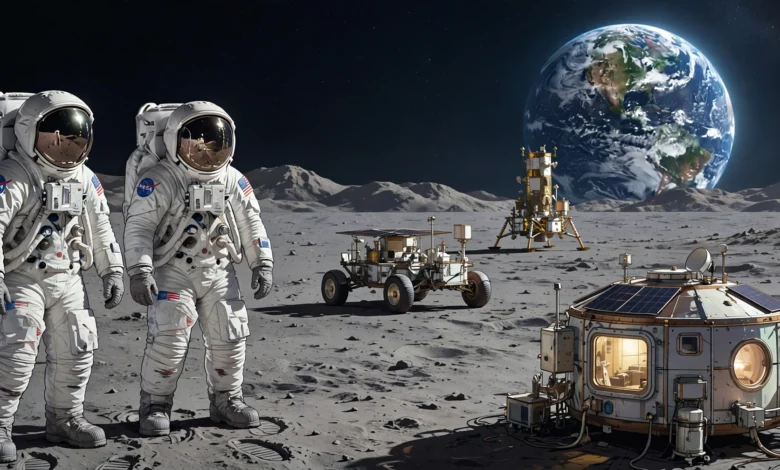
NASA opened applications on Saturday, 7 November 2026, for its next class of astronaut candidates, the men and women who will train to return Americans to the Moon and prepare the first crewed missions to Mars. U.S. citizens have until 11:59 p.m. EST on Thursday, 3 December, to apply.
NASA announced the opening during an air show at Kennedy Space Center in Florida, in its first open call for astronauts since 2024. That round drew more than 8,000 applications, and 10 candidates were selected in 2025.
The new class is being hired for the Moon Base
The recruits will join NASA as it returns to the Moon, builds the Moon Base, and lays the groundwork for the first crewed missions to Mars. They will train to operate on the lunar surface, live and work beyond Earth, and fly missions that push human exploration farther than ever before.
“The people we select could walk on the Moon, live and work at the Moon Base, and help pioneer the systems and operations that will ultimately carry crews to Mars,” NASA Administrator Jared Isaacman said.
The agency needs the reinforcements. NASA has just 32 active astronauts, and Artemis III commander Randy Bresnik told the Associated Press on Saturday that the current workload far exceeds the number of available crew members. This will be NASA’s 25th astronaut class since the original Mercury Seven were announced in 1959, and only 370 people have ever been selected as astronaut candidates.
Where the Artemis programme stands
Artemis II flew four astronauts around the Moon on 1 April 2026 — Reid Wiseman, Victor Glover and Christina Koch of NASA, and Jeremy Hansen of the Canadian Space Agency — the first humans to travel near the Moon in more than 50 years. Artemis III is due late in 2027 as a docking and lander test in Earth orbit, with SpaceX’s Starship and Blue Origin’s Blue Moon landers taking turns docking with the Orion capsule.
NASA aims to return astronauts to the lunar surface in 2028. The new class will not fly straight to the Moon, though: selection is the start of a long process, and the size of the class has not been announced.
Who can apply
| Requirement | What NASA asks for |
|---|---|
| Citizenship | United States citizen |
| Education | Master’s degree in a STEM field — engineering, biological science, physical science, computer science or mathematics — from an accredited institution |
| Substitutes for the master’s | Two years of doctoral work, a medical degree, or Test Pilot School |
| Experience | At least three years of related professional experience after the qualifying degree; pilots can qualify with 750 hours of pilot-in-command time in high-performance jets |
| Medical | Must pass NASA’s long-duration astronaut flight physical; Test Pilot School and medical residency must be finished by July 2027 |
Neither military service nor flying experience is required, according to NASA’s selection FAQ. Chief astronaut Scott Tingle chairs the Astronaut Selection Board at Johnson Space Center in Houston.
From application to launch: the timeline
| When | What happens |
|---|---|
| 7 November 2026 | Applications open |
| 3 December 2026, 11:59 p.m. EST | Application deadline |
| December 2026 – April 2027 | Application review, then interviews and assessments at Johnson Space Center |
| Late 2027 | Final selection announced |
| Early 2028 | New candidates begin training |
Applications are submitted through NASA’s application portal, which leads to the federal USAJOBS posting. The recruitment drive comes as American technology companies reshape their own plans — Tesla will wind down Cybertruck production in mid-2027 as it shifts its Texas plant to the Cybercab.
For anyone who has ever dreamed of going, this is the class to try for. The people NASA picks could end up living and working on the Moon, just as the agency sets out to build a permanent home there.