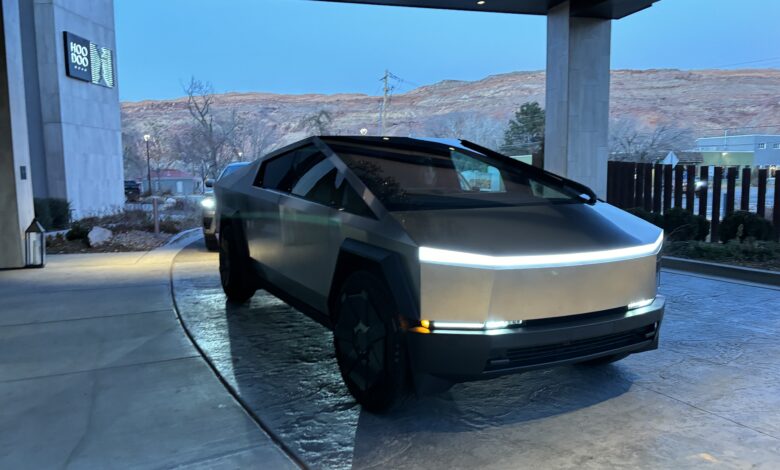
Tesla will wind down production of its Cybertruck electric pickup at Gigafactory Texas around the middle of 2027, chief executive Elon Musk said on Friday, 6 November 2026. Tesla Cybertruck production ends so the Austin plant can make room for higher output of the Cybercab, the driverless two-seater at the centre of Musk’s robotaxi plans.
Musk confirms the Texas switch on X
Musk announced the decision in a post on X, writing: “Tesla will be winding down production of the Cybertruck at Gigafactory Texas around the middle of next year to make room for increased Cybercab production.” The post named no new factory for the pickup and no final edition before the line stops.
The Cybertruck’s official X account posted a video early on Friday of the vehicle driving into the sunset, hours before Musk confirmed the wind-down. The announcement closes the book on one of the most talked-about vehicles of the decade, less than four years after the first customer deliveries.
Why Tesla Cybertruck production ends now
Sales never reached the scale Musk once predicted for the angular stainless-steel pickup. Tesla sold about 59,000 Cybertrucks in the United States across 2024 and 2025, according to Cox Automotive, against factory capacity of more than 125,000 a year at Gigafactory Texas.
| Period | US Cybertruck sales | Change |
|---|---|---|
| 2024 | 38,965 | — |
| 2025 | 20,237 | Down 48% |
| First nine months of 2026 | 11,586 | Down 28% year on year |
The figures come from Kelley Blue Book and Cox Automotive data reported by Reuters and MarketWatch. The pickup also faced a series of safety recalls since its launch, and last month Tesla told reservation holders in Australia and New Zealand that it would not build a right-hand-drive version, refunding deposits from customers who had waited up to seven years.
The announcement came in a week when technology stocks were under pressure, including the Nasdaq’s sharp sell-off as investors reassessed high-priced growth shares.
The Cybercab takes the factory floor
The Cybercab is a gold-toned two-seater with butterfly doors and no steering wheel, pedals or mirrors. Musk has described it as the main vehicle for a global robotaxi network, and Tesla began offering paid rides in a small Cybercab fleet in Austin in September 2026.
About 570 of the more than 1,200 Tesla robotaxis operating in Texas are Cybercabs, with the rest mainly Model Y vehicles, according to the state’s Department of Motor Vehicles. MarketWatch reported that Tesla aims to begin selling the Cybercab to the public by the end of the year.
Regulators are still examining the vehicle. The US National Highway Traffic Safety Administration opened an investigation in September 2026 into whether Tesla properly self-certified the Cybercab as compliant with federal motor vehicle safety standards.
A short run for Tesla’s boldest vehicle
The Cybertruck reached customers in late 2023 after years of delays, and a mid-2027 end would give it a production run of about three and a half years. That would make it the shortest-lived production car in Tesla’s history, shorter even than the original Roadster’s three years and ten months.
Tesla has already reshaped its factories around the same strategy. A few months ago it stopped building the older Model S and Model X at Fremont, California, and redirected that capacity toward production of its Optimus humanoid robot.
The same week brought another sign of consolidation in technology, with the reported Unity takeover talks valuing the game-engine maker at $25 billion in a deal involving Silver Lake and Saudi Arabia’s Public Investment Fund.
What it means for Cybertruck owners
Reuters reported that the Austin plant is the only Tesla facility equipped to manufacture the truck’s specialised components, and it was not immediately clear whether production would move elsewhere or stop entirely. Musk’s post announced no change to servicing or parts support for existing trucks.
Owners keep their vehicles, and no replacement pickup has been announced. For now, the Cybertruck’s future is the one Musk sketched on Friday: a factory floor in Texas given over to driverless taxis.
Frequently asked questions
When does Tesla Cybertruck production end?
Around the middle of 2027, at Gigafactory Texas in Austin. Musk announced the wind-down on 6 November 2026.
Why is Tesla ending Cybertruck production?
Weak sales and factory capacity. Tesla sold 20,237 Cybertrucks in the US in 2025, down 48% from 2024, and 11,586 in the first nine months of 2026, down 28% year on year. The Texas line is being converted to build more Cybercabs.
What is the Cybercab?
Tesla’s purpose-built robotaxi: a gold two-seater with butterfly doors and no steering wheel, pedals or mirrors. Paid rides began in Austin in September 2026, and Tesla aims to start selling it to the public by the end of the year.
Will Tesla still support existing Cybertrucks?
Musk’s announcement included no change to servicing or parts support for trucks already on the road. No move of Cybertruck production to another factory has been announced.