
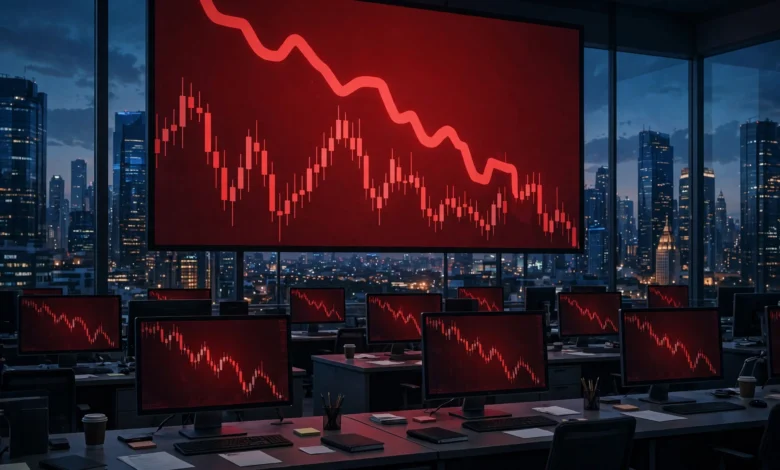
The Nasdaq Composite plunged 5.52% on Thursday, November 5, 2026, sliding into correction territory as a brutal sell-off in artificial intelligence and semiconductor stocks erased Wall Street’s post-election rally in a single session. The rout spread to Asia overnight, where Japan’s Nikkei and South Korea’s Kospi fell sharply on Friday morning.
The Dow Jones Industrial Average lost 1,833.06 points, or 3.44%, to close at 51,523.06, while the S&P 500 dropped 334.89 points, or 4.36%, to 7,353.73. The Nasdaq fell 1,421.52 points to 24,315.00, its worst day since April 2025 and its lowest close in more than six months.
From election rally to rout in 24 hours
Wall Street’s celebration after the election lasted exactly one day. On Wednesday, the first trading day after the November 3 vote, the Dow jumped 1,569.40 points, or 3.03%, to 53,356.12, its best day since April 9, 2025, as investors welcomed a settled result.
Thursday wiped out that entire gain and then some. The trigger, according to analysts quoted in the day’s coverage, was the Democrats’ midterm sweep of Congress and several key governor’s offices, which traders read as a threat to the AI infrastructure buildout. Investors fear tighter regulation of artificial intelligence and slower, more expensive data-center construction in the states where the biggest projects are planned.
“The obvious catalyst for the sharp selloff is that markets are pricing in the midterm results,” Jakub Rochlitz of eToro said, according to Fox Business. “The market’s interpretation is that the AI infrastructure buildout will become slower and more expensive.”
Chip stocks led the collapse
Semiconductor shares took the heaviest damage. The Philadelphia Semiconductor Index plunged 12.25% to 9,011.14, its worst session since 2020, as investors questioned whether the enormous sums being poured into AI infrastructure will ever earn their expected return.
| Stock / Index | Thursday’s move | What happened |
|---|---|---|
| Nasdaq Composite | −5.52% | Entered correction, more than 10% below its October 6 record |
| S&P 500 | −4.36% | Worst day since April 2025 |
| Dow Jones | −3.44% | Lost 1,833 points, erasing Wednesday’s rally |
| PHLX Semiconductor Index | −12.25% | Worst day since 2020 |
| Nvidia | −9.26% | Fell to $181.60, losing almost $450 billion in market value |
| AMD | More than −15% | Double-digit loss despite strong AI chip demand |
| Micron | About −17% | Memory-chip sell-off hit hard |
| Tesla | −10.77% | Biggest loser among the mega-cap names |
| Broadcom | −10.4% | Chip and infrastructure weakness |
| Hut 8 | −23.23% | Data-center builder among the day’s worst performers |
Nvidia, the chipmaker that has become the face of the AI boom, fell 9.26% to $181.60 and was by far the heaviest weight on the S&P 500. AMD chief executive Lisa Su pushed back on the selling, saying the market is “a little short-sighted” and that she sees no slowdown in demand for AI chips.
Chip stocks were already under pressure before Thursday. Intel shares plunged 29% last week in their worst day since 1974 after a weak forecast overshadowed a strong quarter, a reminder that even the sector’s giants are not immune to a sudden change in sentiment.
Fear gauge spiked as investors rushed for safety
The VIX, Wall Street’s fear gauge, surged nearly 70% to around 28 as traders rushed to hedge against further losses. Data-center names were among the worst hit, with CoreWeave down 9.90% and IREN, Applied Digital and Nebius Group each losing more than 14%.
Even the hyperscalers were not spared. Meta fell 3.96%, while Amazon and Alphabet each dropped about 2.2%. One bright spot in the economic data offered little comfort: initial jobless claims fell to 189,000, down 6,000 from the previous week’s revised level of 195,000.
The sell-off spread across Asia on Friday
Asian markets followed Wall Street lower on Friday. Japan’s Nikkei 225 fell 5.7% by midday after dropping as much as 7.1% during the session, putting it on track for its worst week since March 2025. South Korea’s Kospi plunged more than 8% at one point, triggering a circuit breaker that halted trading for 20 minutes, before recovering slightly to a 7.4% loss.
Samsung Electronics fell nearly 10% and SK hynix dropped more than 11%, while SoftBank Group slid 9.3%. TradingView reported that the Nasdaq’s drop left it at its lowest closing level in over six months, with lingering doubts about whether heavy AI spending can generate sufficient returns.
What it means for retirement savers
For Americans watching their 401(k) balances, Thursday was a painful day, but financial advisers quoted in the day’s coverage cautioned against making sudden changes to retirement investments in response to market volatility. A correction, defined as a fall of at least 10% from a recent peak, is a normal feature of bull markets, even when it arrives as violently as this one did.
The Dow and the S&P 500 remain well short of correction territory measured from their own records. The Nasdaq, the Nasdaq-100 and the semiconductor index have each crossed the 10% threshold, which is why the technology-heavy index is now the focus of the market’s anxiety.
What to watch when US markets reopen
US stock futures pointed lower early on Friday, with S&P 500 futures down 0.6% and Nasdaq-100 futures down 0.8%. Traders will watch whether dip buyers step in when New York opens at 9:30 a.m. Eastern, or whether the selling gathers pace for a second day.
The deeper question is whether Thursday was a sharp but short-lived repricing of the AI trade or the start of a longer reckoning with the cost of the data-center boom. For now, the market that spent two years betting without hesitation on artificial intelligence has discovered doubt, and it arrived all at once.






One Comment