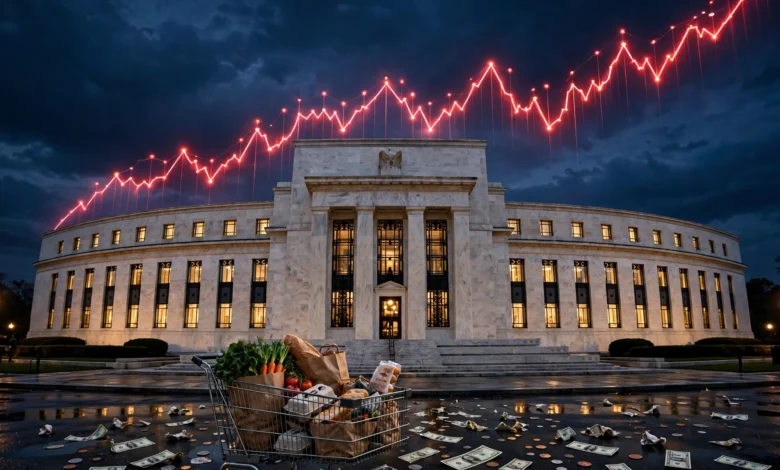
US inflation picked up again in October, the Commerce Department said on Wednesday, November 25, 2026, with the Federal Reserve’s preferred price gauge rising 3.8 percent from a year earlier — nearly double the central bank’s 2 percent target and the hottest reading in months. The report landed two weeks before the Fed’s final policy meeting of the year, strengthening the case for another interest rate rise in December.
The personal consumption expenditures price index rose 0.3 percent in October from September, according to the Bureau of Economic Analysis, matching economists’ forecasts. Excluding volatile food and energy prices, the core index also rose 0.3 percent for the month and 3.3 percent from a year earlier, up from 3.1 percent in September and slightly above the 3.2 percent Wall Street had expected.
The October numbers, at a glance
The headline rate accelerated from a revised 3.7 percent in September, while the monthly pace cooled from 0.5 percent. On a three-month annualized basis, core inflation ran at 3.6 percent, up from 3 percent in September, a sign that underlying price pressures are building rather than fading.
| Measure | September 2026 | October 2026 |
|---|---|---|
| PCE price index, year over year | 3.7% | 3.8% |
| Core PCE price index, year over year | 3.1% | 3.3% |
| PCE price index, month over month | 0.5% | 0.3% |
| Core PCE price index, month over month | 0.3% | 0.3% |
| Personal income | +0.3% | +0.7% |
| Consumer spending | +0.6% | +0.3% |
| Personal saving rate | 3.6% | 4.1% |
The figures arrived on a day when markets were already on edge. Wall Street’s sharp rebound earlier in the week had revived bets that the Fed will keep tightening, and the October inflation data did nothing to soften that view.
Paychecks grew, but shoppers pulled back
Americans earned more in October — personal income rose $201.8 billion, or 0.7 percent, more than double September’s 0.3 percent gain. The Bureau of Economic Analysis said the increase reflected higher compensation, government social benefits and dividend income, with the benefits figure boosted by one-time payments tied to a Medicare premium rebate.
After taxes, disposable personal income rose 0.8 percent, and adjusted for inflation it climbed 0.5 percent, reversing a 0.2 percent decline in September. Yet spending did not keep pace. Consumer spending rose $63.8 billion, or 0.3 percent, with $11.8 billion more spent on goods and $52.1 billion more on services — but once inflation is stripped out, real spending actually slipped by $5.8 billion.
Instead of spending the extra income, households saved it. Personal saving reached $1.00 trillion in October, lifting the saving rate to 4.1 percent from 3.6 percent in September. The split — rising incomes, flat real spending, higher saving — points to a consumer growing more cautious just as the holiday shopping season begins.
All eyes turn to the Fed’s December meeting
The Federal Open Market Committee meets on December 8–9, with its rate decision due at 2:00 p.m. Eastern on Wednesday, December 9, alongside updated economic projections. The Fed held its benchmark rate at 3.75 percent to 4 percent in October, with two officials dissenting in favor of a hike, and futures markets now put the odds of a quarter-point rise in December at roughly 95 percent, according to CME FedWatch. The Fed’s published meeting calendar confirms the December gathering is the last scheduled decision of 2026.
Traders had already moved in that direction after Nvidia’s dramatic leadership reversal helped ignite a market rally earlier in the week. A December hike would take the target range to 4.00 percent to 4.25 percent, and futures pricing also points to at least two more quarter-point increases by mid-2027.
What it means for households this Thanksgiving
The report lands on the eve of Thanksgiving, with millions of Americans traveling and holiday spending about to peak. Prices are still climbing at nearly twice the Fed’s target pace, and the flat real spending figure suggests many families are already feeling the squeeze, even as their paychecks grow.
For now, the data gives the Fed little reason to pause. The next reading on inflation, covering November, is due from the Bureau of Economic Analysis on December 23 — two weeks after the December decision, and the last major economic report of the year.