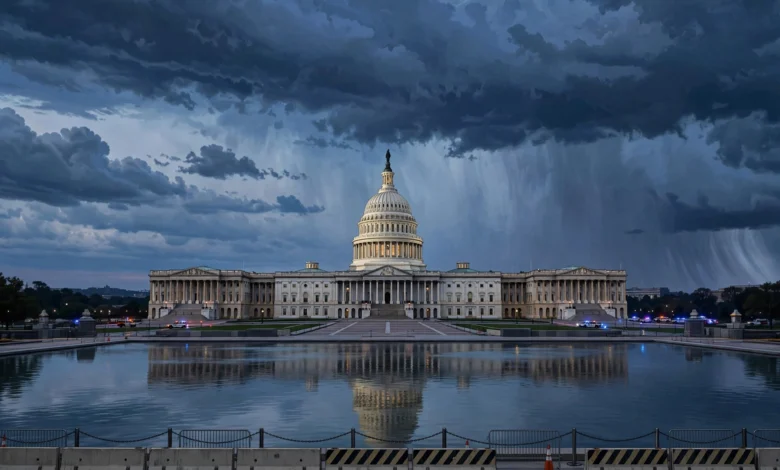
New US intelligence indicates that Iran is developing plans to target senior Trump administration officials by detonating a dirty bomb or a chemical weapon in Washington, DC, according to seven US officials cited by CNN. The report, published on Monday, 16 November, has set off a flurry of contingency planning inside the administration, even as officials stress there is no sign of an imminent attack.
President Donald Trump, speaking to reporters on Tuesday during his tour of Asia, said Iran would “pay a price the likes of which no country has ever paid before” if it attacked Washington, adding that his administration was taking the matter “seriously.” The White House, meanwhile, said it is “monitoring any and all potential threats, but at this time there are no credible threats to the homeland.”
What US intelligence picked up
Sources familiar with the latest intelligence told CNN that the Iranian planning is, for now, an effort to give Tehran options rather than an indicator that an attack is about to happen. Two of the sources said the plotting picked up by the United States has been very specific, including locations and targets.
There is no evidence that Iran has decided to move forward, and officials continue to debate whether Tehran can or will attempt to carry out such a plot. “Whether they actually have the personnel in place to execute is a matter of debate,” one of the sources said.
Officials have held several meetings over the past week to discuss how to counter the threat, planning that one source described as “prudent.” The warnings also prompted the Secret Service to move Treasury Secretary Scott Bessent into military housing last week.
US intelligence has also picked up Iranian chatter claiming that bomb-making materials have been stashed inside the United States. Officials are divided over how credible that intelligence is, but broadly believe it would be very easy — and is even likely — that Iran has already pre-positioned nuclear materials or chemical agents that could be laced onto a conventional weapon.
Trump and his cabinet respond
Trump addressed the report on Tuesday after landing in Manila for the first leg of his Asian tour. He is in the region this week and is due in Shenzhen on Thursday for a three-way summit with Xi Jinping and Vladimir Putin, where US officials say the war in Iran is also expected to come up.
Homeland Security Secretary Markwayne Mullin called the Iranian planning “aspirational,” adding that it did not constitute a “new threat.” But he warned that carrying out such an attack would trigger an “all-out war.” “If you were to go after one of our cities or go after Washington, DC, you would cause an all-out war,” Mullin said on CNBC, according to CNN’s report on the administration’s reaction.
American officials have viewed the intelligence as a signal of an alarming willingness to escalate by Iran as it faces intense pressure from ongoing US military strikes and a punishing economic blockade that top administration officials have described as “devastating” to the country. The Defense Department referred questions to the Office of the Director of National Intelligence, which declined to comment.
What a dirty bomb would — and would not — do
A dirty bomb is very different from a nuclear bomb. It packages radioactive material into a conventional explosive, spreading dangerous airborne radiation over an area without any nuclear-fission reaction.
| Dirty bomb | Nuclear bomb | |
|---|---|---|
| How it works | Conventional explosive disperses radioactive material | Nuclear-fission chain reaction |
| Destructive power | Similar to a conventional bomb | Exponentially more destructive |
| Radiation spread | Blocks or even miles | Vast fallout over a wide area |
| Main danger | Explosion itself; fear and contamination | Blast, heat, radiation and fallout |
Experts say casualties from a dirty bomb would most likely be caused by the explosion itself rather than the radiation. “Any weapon like that is a weapon of terror, not a weapon of precision, just like a suicide bomber blowing themselves up,” one source familiar with the intelligence said. “They can make people really sick and certain areas uninhabitable.”
Officials cautioned that the United States is vulnerable to an attack with unconventional weapons because dirty bombs are relatively easy to assemble. Iran would not necessarily need to smuggle trained operatives into the country — it would only need to convince a person already living inside the United States to carry out the attack.
Tehran denies the report
Iran has rejected the reporting outright. A spokesperson for the Iranian Mission at the United Nations in New York said Iran “considers the use of chemical weapons under any circumstances to be wholly illegitimate and categorically rejects and unequivocally refutes the false and fabricated allegations circulated in this regard.” The spokesperson did not explicitly address the intelligence about a potential dirty bomb plan.
Foreign Ministry spokesman Esmaeil Baghaei wrote on social media on Tuesday that those who started the war “are attempting to manufacture a veneer of legitimacy for further aggression and atrocities.” Foreign Minister Abbas Araghchi also rejected the report, comparing it to “Iraq War-style propaganda.” Tehran described the allegations as baseless, according to Reuters.
A wider pattern of threats
The Washington warning is not the only concern reaching US officials. A separate stream of intelligence suggests Iran may use chemical weapons against American troops stationed in the Middle East, according to two officials. The New York Times first reported those concerns, and several officials said flatly that US troops do not have adequate protective equipment or training to guard against such an attack.
Iranian plotting against current and former US officials, including a murder-for-hire plot against Trump in 2024, has been going on since the president’s first administration. Until now it has largely concentrated on opportunities to kill US officials while they were travelling overseas.
On Tuesday, North Macedonia and Greece said they had arrested five people over a suspected Iran-linked plot to carry out an assassination in Greece. North Macedonia’s National Security Agency said the network acted under the instructions of an Iranian citizen linked to Iran’s security services.
The swirling threats have also sharpened a separate fight in Washington. A key surveillance law that allows officials to collect foreigners’ communications expired in June, and the attorney general, the director of national intelligence and the CIA director urged Congress in a letter last week to reauthorise it, warning that delay would put American lives at risk.
Why the warning lands now
The United States and Iran remain locked in conflict in the Strait of Hormuz, and talks aimed at ending the American blockade, opening the strait and bringing an end to hostilities have so far failed to produce results. Trump declared last week that the war would be over “fairly soon,” but neither side appears poised to make any meaningful concessions.
One regional source stressed that the next several weeks will be critical for reaching any sort of agreement — and that during that window, certain parties could look to play “spoiler.” Among those to watch are Iranian hardliners or rogue elements of the regime who have benefited from the war and could be incentivised to launch an attack to keep the conflict going.
One US official emphasised that Iran understands the risk of retaliation it would bring upon itself if it moved to use either of these weapons, in the Middle East or in the United States. But if Iranian leaders come to view the survival of the regime as in question, they may consider it worth the risk.
Frequently asked questions
What is a dirty bomb?
A dirty bomb is a conventional explosive packed with radioactive material. It spreads radiation over an area when it detonates, but it does not cause a nuclear explosion and is far less destructive than a nuclear bomb.
Is there an imminent threat to Washington, DC?
No. US officials say the Iranian planning is about giving Tehran options, not a sign of an imminent attack, and the White House says there are currently no credible threats to the homeland.
What did President Trump say about the report?
Trump said on Tuesday that Iran would “pay a price the likes of which no country has ever paid before” if it attacked Washington, and that his administration was taking the matter “seriously.”
What has Iran said?
Iran’s mission to the United Nations called the allegations false and fabricated, and its foreign ministry spokesman described them as baseless and an attempt to justify further aggression.
What is the United States doing about it?
Officials have held several meetings over the past week on countermeasures, the Secret Service has moved Treasury Secretary Scott Bessent into military housing, and intelligence chiefs are pressing Congress to reauthorise a surveillance law that expired in June.