
Fiona Goodall: The New Zealand Photojournalist Behind Sport, Breaking News and Human Stories
From the intensity of international rugby to the realities of life on a vulnerable Pacific island, Fiona Goodall has built a photographic career around moments that deserve to be remembered.

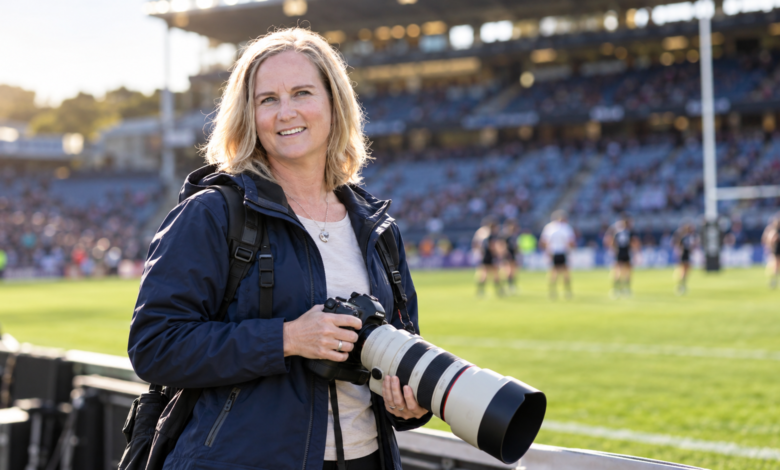
Fiona Goodall is a name that appears across news photographs, sporting events, public appearances and documentary photography. Yet the photographer behind these images is less widely known than many of the people whose lives and achievements she captures.
Based in Auckland, New Zealand, Goodall has spent decades working in photojournalism, first in newspaper journalism and later as a freelance photographer contributing to major photographic assignments. Her portfolio spans the 2011 Rugby World Cup, the aftermath of the Christchurch earthquake, the Women’s Rugby World Cup in 2022 and documentary work examining everyday life in Tuvalu.
What makes her career especially interesting is the range of situations it encompasses. A photographer covering an international rugby final must anticipate split-second action. Someone documenting the aftermath of a natural disaster faces a very different responsibility: recording events with accuracy, sensitivity and an awareness that images may become part of the historical record.
BLUF: Fiona Goodall is an Auckland-based New Zealand photographer and photojournalist known for news coverage, major rugby events, corporate assignments and documentary photography. Her documented career includes newspaper work with Fairfax NZ, freelance assignments for photographic agencies including Getty Images, and a 2018 project documenting life in Tuvalu. Source: Panasonic’s Getty Images × LUMIX profile.
Fiona Goodall at a Glance: The Facts Behind the Photographer
Goodall’s public profile is centred on her professional work rather than celebrity, entertainment or a heavily publicised personal life. The most reliable sources for understanding her career are her professional portfolio, her interview with Australian Photography and the published credits accompanying her photographs.
Quick Profile
| Profile detail | Verified information |
|---|---|
| Full name | Fiona Goodall |
| Profession | Photographer and photojournalist |
| Base | Auckland, New Zealand |
| Primary specialities | News, sports, corporate events and documentary photography |
| Newspaper background | Approximately 18 years in newspaper photojournalism, mostly with Fairfax NZ, according to her Panasonic profile |
| Freelance career | Works across photographic agencies and media assignments, according to her published professional biography |
| Sports coverage | 2011 Rugby World Cup and 2022 Women’s Rugby World Cup |
| Documentary project | Life in Tuvalu, photographed in August 2018 |
| Public portfolio | Fiona Goodall’s photography website |
| Verified net worth | No authoritative public figure identified |
The distinction between confirmed details and unanswered questions matters. Her professional biography establishes the nature and breadth of her work, but it does not provide a reliable account of her date of birth, education, complete family history or personal finances.
The Newspaper Career That Shaped Her Photographic Instincts
Goodall’s background in newspaper photojournalism helps explain why her work extends beyond conventional sports and event photography.
According to Panasonic’s published profile, she spent approximately 18 years working as a photojournalist for newspapers, with most of that period associated with Fairfax NZ. That experience placed her within a profession where photographers must recognise a developing story, work under deadline pressure and deliver images that communicate an event clearly.
News photography rewards more than technical ability. The photographer needs to understand which moments matter, how people react under pressure and where the decisive action is likely to occur.
A photograph can be technically flawless yet fail to explain what happened. Conversely, an image made in a fraction of a second can become a defining visual record when it captures an important reaction, decision or consequence.
Goodall has described this connection between news and sport in her own words. Speaking to Australian Photography in November 2022, she explained: “I try and take my news experience into my sports photography.” Read the interview.
That observation provides a useful framework for understanding her work. She does not approach sport simply as a sequence of physical movements. Her stated method is to watch for moments with a wider narrative value, including confrontations, decisive tackles, emotional reactions and the circumstances surrounding a result.
Her professional biography also describes a transition into freelance photography after the birth of her second daughter. Rather than remaining confined to newspaper assignments, she expanded into work for photographic agencies and media organisations covering sport, news and corporate events.
The Sporting Moments That Defined Her Career
Goodall’s work in sports photography provides some of the clearest evidence of her long experience in fast-moving environments. Rugby, in particular, features prominently in her professional biography and published interviews.
Photographing the 2011 Rugby World Cup
New Zealand’s successful 2011 Rugby World Cup campaign was one of the assignments highlighted in Goodall’s professional profile. She covered the tournament, including the final in which the All Blacks defeated France 8–7 on 23 October 2011.
The significance of an assignment like this extends beyond obtaining a photograph of the winning team. An international final unfolds through moments that cannot be recreated: a tackle, a player’s expression, a referee’s decision, the tension before a kick or the celebrations immediately after the final whistle.
For a working photojournalist, the challenge is deciding where to position oneself before the decisive moment arrives. The best image may last for less than a second, and there may be no opportunity to correct a missed shot.
Goodall’s newspaper experience was well suited to that pressure. Her own account of sports photography emphasises anticipating what could become tomorrow’s headline, rather than waiting for an obvious highlight to happen.
Nine Years Following the New Zealand Warriors
Another detail in her published biography is her long association with coverage of the New Zealand Warriors, the Auckland-based professional rugby league club.
Panasonic’s LUMIX profile states that Goodall photographed nearly every Warriors home game over a period of nine years. That sustained involvement differs from covering a single championship or occasional sporting event.
Repeated assignments allow a photographer to become familiar with teams, players, tactics and the rhythms of competition. That knowledge can help with anticipation: understanding which player is likely to break through the defensive line, where a collision may occur and when a routine phase of play could suddenly become decisive.
Familiarity also makes it easier to recognise details that an occasional spectator might overlook. A meaningful sports photograph may show determination, disappointment, exhaustion or a relationship between teammates, rather than simply documenting who scored.
Capturing the 2022 Women’s Rugby World Cup
Goodall’s later work included the 2022 Women’s Rugby World Cup, hosted in New Zealand. In an interview published on 21 November 2022, Australian Photography described her as a freelance photographer working for Getty Images and spoke with her shortly after the tournament.
She discussed photographing the Black Ferns, New Zealand’s national women’s rugby team, and highlighted a memorable sequence involving Stacey Fluhler during the final. Goodall explained that she continued following the action after Fluhler grounded the ball, allowing her to capture a joyful moment that followed the try.
That example reveals something important about sports photography. A score is not always the end of the story. The reaction that follows may better communicate what the moment meant to the player, the team or the crowd.
In the same interview, Goodall discussed the practical difficulty of covering a large competition as part of a team of photographers. One person cannot cover both ends of a field at once, and positioning can determine whether a photographer has a clear view of decisive action.
Her account demonstrates that successful sports photography combines preparation, anticipation, technical proficiency and an understanding of the sport itself.
Beyond the Stadium: Christchurch and the Responsibility of News Photography
Some of Goodall’s most significant assignments have involved events with consequences far beyond sport.
Her Panasonic profile identifies documenting the devastation after the February 2011 Christchurch earthquake among her memorable professional experiences. The earthquake struck on 22 February 2011 and caused extensive damage and loss of life in New Zealand’s second-largest city.
Photographing a disaster presents challenges that differ sharply from those of a sporting event. The photographer must document what has happened while remaining attentive to the people experiencing the event. Images may communicate destruction, but they can also record recovery, community responses and the ordinary details that reveal how a catastrophe affects daily life.
News photographs can eventually become part of the historical record, helping audiences understand events they did not witness themselves. The value of such work rests on accurate documentation, appropriate context and respect for the people being photographed.
The available professional biography confirms that Goodall documented the Christchurch disaster’s aftermath. It does not, however, provide a complete catalogue of her photographs from the earthquake or establish which individual images had the greatest public impact.
That distinction is worth preserving. The documented assignment is significant on its own; there is no need to manufacture awards, specific publication histories or claims about individual photographs to make it seem more important.
Life in Tuvalu: A Different Kind of Photographic Story
Goodall’s documentary work on Tuvalu shows how her interests extend beyond breaking news and sporting competition.
In August 2018, she photographed life in Tuvalu for a project presented through the Getty Images and LUMIX collaboration, titled Life in Tuvalu – Pacific Island Striving to Mitigate Climate Change Effects.
Tuvalu is a low-lying island nation in the Pacific Ocean, where rising seas, coastal flooding and environmental pressures have become major concerns. The project focused on how people live in the islands and prepare for an uncertain future.
In the project description published by Panasonic, Goodall explained that she had long wanted to return to the main island with more time to photograph its people and their way of life. The assignment gave her that opportunity.
Explore the published Tuvalu project and Goodall’s photographs.
Why the Tuvalu project matters
Documentary photography requires a different pace from the work of covering a live sporting event. Instead of anticipating a try or reacting to a breaking-news development, a photographer may need to observe a place, understand its rhythms and make images that communicate something about people’s everyday circumstances.
The Tuvalu project brought together environmental change and human experience. It was not simply a collection of photographs of water or coastlines; its stated aim was to document people’s lives and their preparations for the future.
This type of work also places a premium on context. A compelling photograph of a flooded coastline cannot, on its own, explain the causes of environmental change or predict what will happen to an island nation. Its strength lies in making circumstances visible while leaving broader scientific conclusions to the evidence that supports them.
Goodall’s documented portfolio therefore demonstrates a notable range: fast-paced sports coverage on one side, and a more considered documentary approach on the other.
How Fiona Goodall Works Behind the Camera
Goodall’s 2022 interview offers unusually useful detail about the practical techniques behind her work.
Her equipment list for the Women’s Rugby World Cup included multiple Canon EOS-1D X bodies and a range of lenses for different situations. She said she used the EF 200–400mm f/4L IS USM lens for most of her photographs, with the EF 70–200mm f/2.8L IS III USM lens for crowd images and closer action.
| Working element | What her interview documents |
|---|---|
| Camera bodies | Two Canon EOS-1D X Mark III bodies and one EOS-1D X Mark II |
| Main sports lens | Canon EF 200–400mm f/4L IS USM Extender 1.4× |
| Additional telephoto lens | Canon EF 70–200mm f/2.8L IS III USM |
| Other lenses | Wide-angle, standard zoom and prime lenses |
| Image workflow | Camera Wi-Fi, voice tags and image transfers during the match |
| Editorial process | Getty Images editors selected, cropped, corrected and captioned images before publication |
| Positioning strategy | Understanding the sport and anticipating where important players might attack |
These details come directly from Goodall’s interview with Australian Photography.
Anticipation matters as much as equipment
Long lenses help sports photographers capture action at a distance, but equipment alone cannot guarantee a strong image. Goodall explained that an understanding of the game and individual players helps distinguish one photographer’s images from another’s, even when both have access to the same event.
Knowing how a player tends to attack or which direction a team favours can help a photographer choose a position before the action unfolds. Goodall also emphasised isolating the players from distracting backgrounds by working from different heights and angles.
The objective is a photograph in which the main action reads clearly. A cluttered background, an obscured face or a poorly timed frame can weaken an otherwise important moment.
The deadline does not end when the shutter clicks
Goodall also described a workflow in which she added voice tags to selected photographs during a match and transferred images using the camera’s built-in Wi-Fi and file-transfer process. Getty Images editors in Australia then reviewed and processed a selection for publication.
This is an important element of professional photojournalism. Capturing the image is only one stage in the process. Correct identification, captions, selection and timely delivery help turn a camera file into a usable news photograph.
For major live events, the demands can be immediate. Editors may need images while the match is still being played or shortly after a significant moment occurs. Speed matters, but so does accuracy.
Her Published Work and Professional Presence Today
Goodall’s public professional footprint can be seen across her portfolio, professional profile and credited photographs.
Her LinkedIn profile identifies her professional base as Auckland, New Zealand, and describes her as self-employed. Her photography portfolio offers another route for examining her published work.
Getty Images credits also document assignments beyond the rugby tournaments for which she is widely profiled. Examples include Auckland’s 2024 New Zealand Television Awards and the 2025 Aotearoa Music Awards.
A representative example is this Getty Images credit from the 2025 Aotearoa Music Awards, which identifies Goodall as the photographer.
These credits are useful evidence of published assignments. They do not, by themselves, establish an exclusive employment relationship, a complete client list or the terms of any individual contract.
Readers who want to examine the photography directly should prioritise her portfolio and the original publication or agency credits. Search-result thumbnails can provide clues about her work, but they do not replace the captions, dates and licensing information attached to the original images.
Financial Picture: What Can Be Established About Fiona Goodall’s Wealth?
There is no authoritative public source identified in the reviewed material that establishes Fiona Goodall’s personal net worth, annual salary or total assets.
Her long career in newspaper photojournalism, subsequent freelance assignments and work across sports, news and corporate events establish a professional history. They do not reveal her personal finances.
Freelance photography income can vary according to assignment frequency, editorial licensing, commercial contracts, equipment costs, travel, insurance and other business expenses. Published photographs may also be licensed under different terms, meaning that an image’s retail licensing price is not necessarily the amount paid to the photographer.
For that reason, assigning Goodall a specific fortune or annual income without documentary evidence would be misleading.
| Financial question | Evidence available |
|---|---|
| Personal net worth | Not authoritatively established |
| Annual earnings | No verified figure identified |
| Salary during newspaper career | No verified public figure identified |
| Getty Images income | Individual earnings and contract terms not established |
| Personal property and investments | No reliable public valuation identified |
| Professional income sources | News, sports, corporate and agency assignments are documented |
A responsible account should leave these figures unestimated unless Goodall discloses them or dependable financial records become available.
What Fiona Goodall’s Career Says About Photojournalism
Goodall’s career brings together three demanding forms of photographic work: documenting major sporting occasions, recording the consequences of breaking news and producing longer-form documentary images.
Each requires a different balance of speed, preparation and judgment. Sports photography rewards anticipation and technical control. Disaster reporting requires an awareness of human consequences and the historical significance of events. Documentary projects require patience and an ability to communicate context through a sequence of images.
Her work on the 2011 Rugby World Cup, the Christchurch earthquake aftermath, the 2022 Women’s Rugby World Cup and the Tuvalu project provides concrete examples of these different approaches.
It also explains why her biography is best understood through her assignments rather than through speculation about her private life. The photographs, the published credits and her own interviews offer meaningful evidence of a professional career without requiring unsupported claims about celebrity status, personal wealth or relationships.
In a field where images can circulate far beyond their original publication, the photographer’s name and the context attached to each image remain important. Those details help readers recognise who created the photograph, understand the circumstances in which it was made and distinguish documented work from claims that have no reliable source.
Frequently Asked Questions About Fiona Goodall
Who is Fiona Goodall?
Fiona Goodall is an Auckland-based New Zealand photographer and photojournalist. Her documented work includes newspaper assignments, international rugby coverage, corporate events and documentary photography. Her professional history includes approximately 18 years in newspaper photojournalism, much of it with Fairfax NZ, followed by freelance work for photographic agencies and media organisations.
What is Fiona Goodall best known for?
Goodall is particularly associated with sports and news photography. Her professional biography highlights the 2011 Rugby World Cup, coverage of the New Zealand Warriors over nine years and photographs documenting the Christchurch earthquake aftermath. She also photographed the 2022 Women’s Rugby World Cup and produced a documentary project about everyday life in Tuvalu in 2018.
Does Fiona Goodall work for Getty Images?
Goodall has published work credited to Getty Images. A November 2022 interview with Australian Photography described her as a freelance photographer working for the agency, while Getty’s published image credits identify her as the photographer for individual assignments. Those records establish a documented professional connection, but they do not establish every detail of her current contractual arrangements.
What is Fiona Goodall’s net worth?
Fiona Goodall’s net worth has not been authoritatively established in the public sources reviewed for this article. Although her work spans newspaper photography, sports coverage, corporate events and agency assignments, none of those facts reveals her personal assets or annual earnings. Online estimates should not be treated as verified without reliable financial documentation or a direct statement from Goodall.
Is Fiona Goodall related to Jane Goodall?
The sources reviewed do not establish a family relationship between photographer Fiona Goodall and the late primatologist and conservationist Jane Goodall. A shared surname is not evidence of a family connection. References or image-search results involving both names should be checked against the original context before assuming that they concern the same person or related individuals.
Where can readers see Fiona Goodall’s photographs?
Readers can explore Goodall’s work through her professional photography portfolio, her published Getty Images photographs and the Getty Images × LUMIX project on Tuvalu. Her interview with Australian Photography also includes examples of her rugby photography and details about her equipment and working methods.
The Lasting Value of a Photographer Who Watches Closely
Fiona Goodall’s professional record is built around moments that cannot simply be repeated. A rugby final, a devastating earthquake and the environmental challenges facing a Pacific island demand different photographic responses, but all require the photographer to recognise what matters while it is happening.
Her documented assignments reveal a career that extends beyond the obvious spectacle of sport. The newspaper background gives context to her approach, the rugby work demonstrates her ability to anticipate action, and the Tuvalu project shows an interest in recording people’s lives and circumstances over a longer period.
The available evidence does not answer every question someone might have about her life. It does, however, establish a substantial professional history—and that is the most meaningful starting point for understanding Fiona Goodall.
Editorial Disclaimer
This article is based on publicly available professional biographies, direct interviews, portfolio information and published photographic credits reviewed as of 16 October 2026. Where authoritative details concerning personal life, earnings or assets were unavailable, no estimates or speculative claims have been presented. Published assignments and professional affiliations are described according to the evidence available; contractual arrangements and other circumstances may change.
